Fill the Pipeline
Google Ads management with published fees, and the spend stays yours
Fill the Pipeline
The fastest way to get leads, and the fastest way to waste money
Google Ads management from CICOR Marketing puts your business in front of people at the moment they search for what you sell, at a cost per lead that makes sense for your business. We audit your market and your account, build tightly grouped campaigns, write the ads, track every call and form, and adjust on a set rhythm. Management fees are published by ad spend tier, and the ad spend stays in your own Google Ads account, paid to Google and never marked up. Every plan starts with a free review of your account.
Google Ads is the one channel where a stranger types “emergency plumber near me” and can be on your site ten seconds later. Nothing else in the Fill the Pipeline group reaches a buyer at that exact moment.
It is also the fastest way to waste money. An account run without discipline pays for searches that have nothing to do with you, sends clicks to a slow home page, and never tracks which ones became calls. The keywords, the ads, the page, and how fast someone acts on the data decide which side of that line you land on.

Who It Fits
Who this is for, and who it is not
This service fits a business that knows what a lead is worth and can answer the phone when it rings: home services, dental and medical practices, law offices, contractors, and business-to-business firms with a clear offer. It fits a $1,500 monthly budget and it fits $20,000.
It is not the right fit for a business that cannot yet say what a new client is worth, or one whose site has no page to send a click to. If that is you, we will say so on the first call, and Landing Pages and Conversion Rate Optimization is usually the better first step.
In practice: a two-truck plumbing company spends $1,800 a month on Google Ads and gets calls, but half are for jobs it does not do. We rebuild the account around the five services it wants, add the negative keywords that block the rest, and send the clicks to a page with the phone number at the top. The report shows what each call cost. This example is illustrative, not a client result.
What Is Included
What is included
DIAGNOSIS
Account and market audit
Before anything changes, we review your keywords, your competitors, the account structure, your tracking, and the pages your ads point to. If you have never run ads, the audit covers your market instead.
PLANNING
Goals and the numbers we measure against
We agree on the metrics before launch: cost per click, cost per lead, cost per acquisition, or return on ad spend. They are targets, not promises, and every report is written against them.
BUILD
Campaign build and ad writing
We build tightly grouped campaigns, write responsive search ads that speak to what the searcher wants, and set the extensions, locations, devices, and schedules that fit your business.
TECHNICAL
Tracking for every call and form
We set up conversion tracking through Google Ads, Google Analytics, and Google Tag Manager so a phone call counts the same as a form. For full dashboards, see Analytics, Dashboards and Call Tracking.
FOUNDATION
Ongoing management on a set rhythm
On the plan cadence we adjust bids, budgets, search terms, ad tests, audiences, and the platform’s automation settings. Routine changes do not wait for your approval.
REPORTING
Monthly report and quarterly review
Every month you get a plain-language report: what you spent, what it brought in, what we changed, and what comes next. Each quarter we review the strategy together.
How We Work
How it works
Setup and launch take two to three weeks from access.
1. Week one. We audit the account and the market, agree on the goals, and set the budget and the tracking.
2. Weeks two and three. We build the campaigns, write the ads, and launch. The first ads are usually live within about ten business days.
3. The first 30 days. The platform needs data before its bidding settles, so we watch the search terms closely and cut waste.
4. Month two onward. Management on the plan cadence, a monthly report, and a strategy review each quarter.
Your part: keep a payment method on file with Google, answer the leads quickly, and tell us before you act on advice from a Google representative.
Why It Matters
Why CICOR Marketing for paid search
We run Google Ads as one part of a plan, not as the plan. The ad brings the click. The page, the offer, and the follow-up decide whether that click becomes a client. When the limit is the site or the speed of your callback, we tell you, and we fix that before asking you to spend more. When the buyer is not searching yet, Paid Social, Display and Local Services Ads does the reaching.
CICOR Marketing is a Google Partner. CICOR Marketing has worked in marketing and IT since 1997, and the same discipline runs across every account.
Start The Conversation
Ask About Google Ads Management
Tell us what you are trying to achieve. CICOR Marketing replies within one business day with next steps.
- A reply from CICOR Marketing within one business day
- A free consultation, limited to 30 minutes
- A plan before any spend
Google Ads Management FAQs
The best platforms for digital advertising depend on the business’s target audience, industry, and campaign objective. Google Search is the dominant platform for capturing existing demand; people actively searching for a product or service are the highest-intent audience available in digital advertising, and search ads place the business directly in front of them at that moment. Google Search works best for service businesses, e-commerce, and any category where qualified prospects actively search for solutions.
Meta (Facebook and Instagram) is most effective for reaching broad consumer audiences and for campaigns focused on awareness, lead generation, and retargeting. Its targeting capabilities are sophisticated, its formats diverse, and its ability to reach audiences based on interests and behaviors makes it valuable for businesses whose customers are not necessarily searching but would respond to a well-targeted message. LinkedIn is the strongest platform for B2B advertising, reaching professionals by job title, industry, company size, and seniority in a context where they are receptive to business-relevant content.
The most effective digital advertising strategies use multiple platforms in coordination; Google to capture active searchers, Meta to retarget visitors and build awareness, LinkedIn for professional audiences, rather than concentrating all investment in a single channel. Platform selection should follow the audience rather than the other way around.
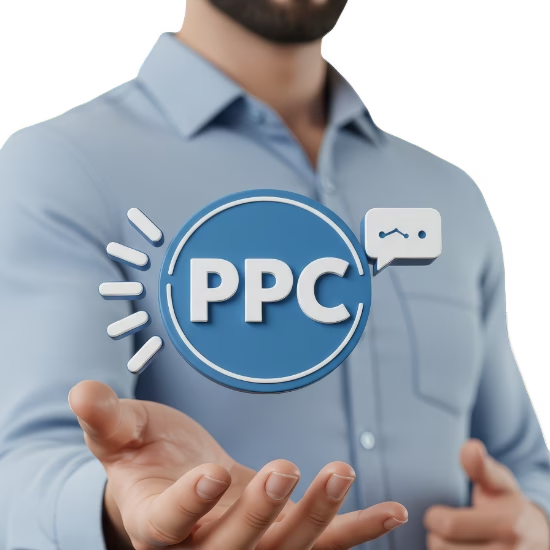
PPC, or pay-per-click advertising, is a digital advertising model where advertisers pay a fee each time their ad is clicked. Rather than paying for broad exposure measured in impressions or airtime, PPC advertisers pay specifically for traffic, each click brings a visitor to the website or landing page, and the cost reflects the competitive value of that audience at that moment. The most common form of PPC is search advertising through Google Ads, where ads appear above organic results when users search for relevant keywords.
PPC operates through an auction. Advertisers bid on the keywords they want their ads to appear for, and the combination of bid amount and ad quality determines placement. Higher bids and higher-quality ads earn better positions at lower effective costs, which is why optimizing ad relevance and landing page quality is as important as the bid amount itself.
For businesses, PPC is valuable because it can generate traffic and results quickly and because performance is fully trackable. Unlike organic search, which takes months to build visibility, a well-structured PPC campaign can produce leads within days of launch. The ability to set daily budgets, pause campaigns, and track every result at every step makes PPC one of the most controllable and measurable forms of advertising available.
The most effective types of digital ads depend on the campaign objective, the funnel stage being targeted, and the industry. Search ads, particularly Google Search, are highly effective for capturing existing demand because they appear at the exact moment someone is searching for what the business offers. They convert well because the audience is actively looking, not passively browsing, which is the highest-intent placement available in digital advertising.
Social ads on Meta, LinkedIn, or TikTok are most effective for building awareness, generating demand among audiences who are not yet searching, and retargeting visitors who came from other channels. Video ads consistently produce higher engagement and brand recall than static image ads, making them particularly valuable for awareness campaigns. Display ads work effectively for retargeting and broad reach at low cost, though they typically require higher volume to generate meaningful conversion results.
For e-commerce, Shopping ads: Google Shopping and Meta Advantage+ Shopping campaigns, are among the most effective formats because they show the product with pricing directly in the ad, creating a more direct path to purchase. The combination of the right ad type for the right objective at the right stage of the funnel, rather than relying on a single format for everything, consistently produces better results than a one-channel approach.
Google Ads operates on an auction system that runs every time someone performs a search. Advertisers select keywords they want their ads to appear for, set bids indicating the maximum they are willing to pay per click, and write ad copy that appears in search results when those keywords are triggered. Ad position is determined by a combination of bid amount and Quality Score; a metric reflecting how relevant the ad, landing page, and keyword are to the user’s query.
The main campaign types include Search (text ads in search results), Display (image and banner ads across websites in Google’s network), Shopping (product listings with images and prices for e-commerce), Video (ads on YouTube), and Performance Max (automated campaigns that use machine learning to optimize across all Google surfaces). Each type serves a different purpose and works best at different stages of the customer journey.
Success with Google Ads depends on three things working together: keyword selection that captures the right intent, ad copy that earns the click, and a landing page that converts the resulting traffic. Advertisers who invest in all three elements and continuously refine them based on performance data consistently outperform those who set up campaigns and leave them to run without active optimization.
PPC (pay-per-click) is a specific pricing model within digital advertising, not a synonym for it. In PPC, advertisers pay a fee each time someone clicks their ad. Digital advertising is the broader category that includes all paid digital placements, encompassing both click-based and impression-based pricing models. While the terms are sometimes used interchangeably in common usage, PPC is one type of digital advertising rather than the full scope of it.
Not all digital ads use the PPC model. Display advertising is often priced on a cost-per-thousand-impressions (CPM) basis, meaning advertisers pay for visibility regardless of clicks. Video ads on YouTube and social platforms can be priced on CPM or cost-per-view (CPV). Some performance-based campaigns use cost-per-acquisition (CPA) pricing, where the advertiser pays only when a defined conversion occurs rather than for each click.
Practically, PPC; most commonly associated with Google Search, is most effective for direct-response goals because the advertiser pays for demonstrated interest (a click) rather than passive exposure. CPM-based digital ads are more appropriate when reaching a large audience matters more than tracking individual actions, such as in awareness campaigns. Understanding which pricing model aligns with the campaign objective helps in selecting the right platform, format, and approach.
Digital ads are paid marketing messages delivered through online platforms: search engines, social media networks, websites, streaming services, and mobile apps. Unlike organic content, digital ads guarantee placement in front of a targeted audience in exchange for a fee, typically charged per click, per thousand impressions, or per action completed. The primary platforms for digital advertising include Google, Meta (Facebook and Instagram), LinkedIn, YouTube, Amazon, and display networks serving ads across millions of partner websites.
What distinguishes digital ads from traditional advertising is the precision of targeting and the depth of measurability. Rather than paying for broad exposure with uncertain reach, digital ads can be shown to people in defined geographic areas, specific demographics, interest groups, or behavioral profiles. Every impression, click, and conversion can be tracked, making it possible to calculate what each campaign is generating in return for the investment.
Digital advertising encompasses multiple formats: search text ads, social image and video ads, display banners, shopping listings, and sponsored content, each suited to different objectives. At the broadest level, digital ads exist to drive specific, measurable outcomes: website traffic, leads, sales, brand awareness, or app downloads. The defining strength of digital advertising is that these outcomes can be tracked, optimized, and scaled based on what the data shows is working.
Retargeting ads are important because most people who visit a website for the first time do not convert immediately. Research consistently shows that only a small fraction of first-time visitors take the desired action; submitting a form, making a purchase, or calling the business. Retargeting keeps the brand visible to those prospects as they continue browsing elsewhere, maintaining presence throughout their decision process until they are ready to act.
The effectiveness of retargeting comes from relevance. Rather than showing a generic ad to a broad cold audience, retargeting reaches people who have already demonstrated interest; they visited the website, watched a video, opened an email, or engaged with a social post. This prior signal makes the audience far more receptive to follow-up messaging, which is reflected in consistently higher click-through and conversion rates compared to prospecting campaigns.
Retargeting is particularly valuable for longer sales cycles. For services or products that take days, weeks, or months to decide on, retargeting ensures the business remains visible throughout that period rather than being forgotten after the first visit. When the prospect eventually reaches the decision point, the familiarity built through retargeting makes the business significantly more likely to be chosen over competitors that did not maintain that presence.
PPC advertising costs vary significantly based on industry, platform, keyword competition, and campaign objective. On Google Search, cost-per-click ranges from under a dollar in low-competition categories to $50 or more in highly competitive industries like legal services, finance, insurance, and medical. The total cost of a PPC campaign is determined by the daily or monthly budget the advertiser sets, combined with how many clicks that budget purchases at the prevailing CPC in the market.
There is no universal minimum budget for PPC, but the budget needs to be sufficient to generate enough data to support optimization decisions. A campaign generating only one or two clicks per day cannot produce enough signal to improve meaningfully. A practical minimum for most markets is a budget that generates 30 to 50 clicks per week, which in competitive categories typically means at least $500 to $1,000 per month, though simpler campaigns in lower-competition markets can be effective on less.
The most useful framework for evaluating PPC cost is relative to the business’s economics: what is a new customer worth, and what cost per acquisition would make the channel profitable? Working backward from that number establishes what CPCs and conversion rates are needed for PPC to make sense, and sets the benchmark against which actual performance should be measured. Businesses that start from this framework are better positioned to evaluate early results and decide whether to scale, optimize, or stop.
Ready When You Are
Find out what your account is paying for
Most accounts we review pay for searches the owner would never approve, or send clicks to a page that never asks for the call. The review shows what we found and what we would change first. It is free, and you can act on it with or without us.